Showing posts with label Chinese. Show all posts

Wednesday, October 14, 2015

Chinese Compositions - Final Preparations

Date:  Oct 14, 2015

Tomorrow is the Chinese SA2 Paper 1 exam, which is the Chinese Composition.  50 minutes to write at least 80 words.

This is how I am going to prepare Jay.

IMG 2009

[Revisions]

1.  Print out all the compositions that he has done, and asked him to read.  

IMG 2061

[Encouragement]

2.  While reading, I will highlight those easy words to start the sentence with a market pen.  Make him feel good.  Encourage him.  And teach him what are the words he used will get more points.

[Incentives]

3.  No more new writings.  It is enough for the past month for him to do all these Compo writings.

4.  Let me play at least 30 minutes of iPad/Games before sleep.  :)  


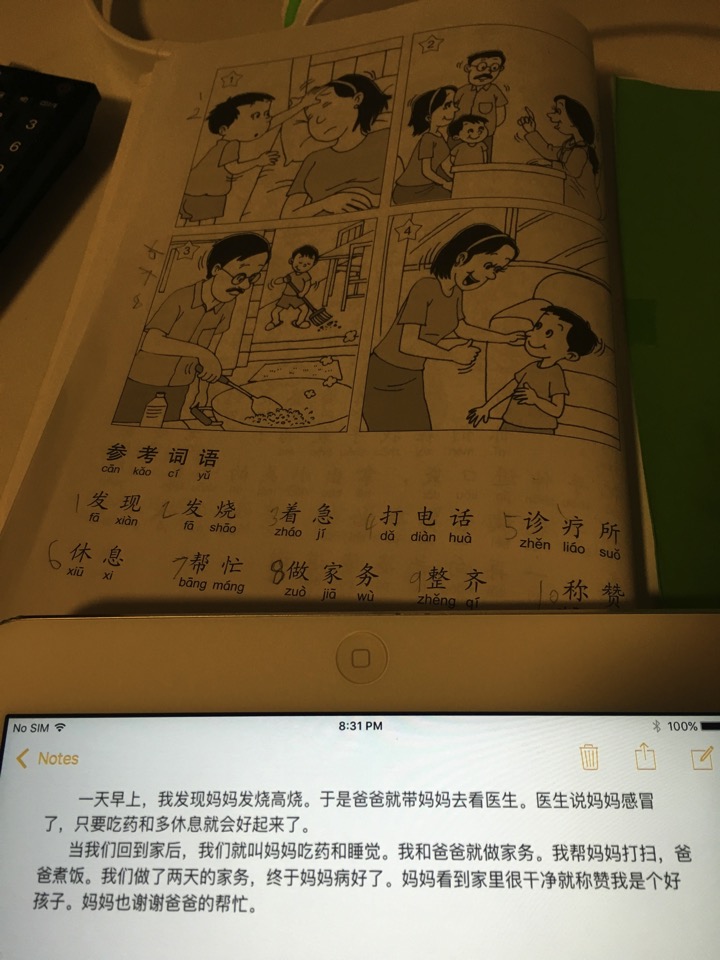
Here are some of the 满江红 compositions that I would like to share.  It is interesting.  These are the past 3 days compositions he has done using writing, instead of dictations on the iPad/iPhone.  And I think he learned a lot from the past few days, especial learn how to open the sentence.

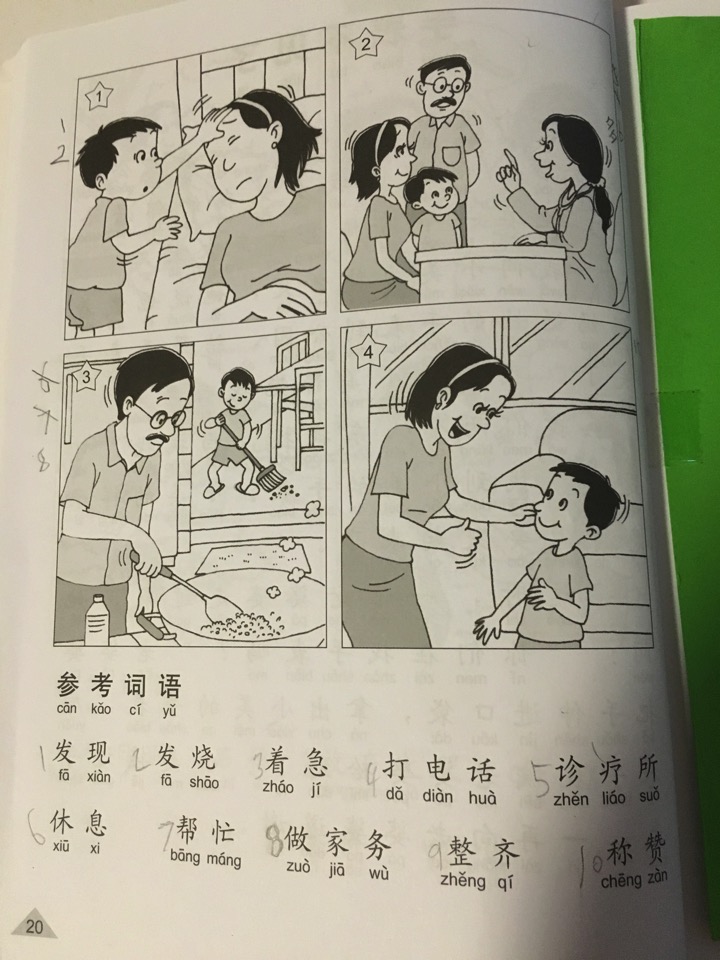
[Example 1]  This is to describe what do you do on a Sunday morning.
IMG 2062

When he first wrote it, most of the sentence structure seems correct.  But the content does not match closely to the pictures given.  So, I decided to scrutinise the Compo and teach him how to use some useful words to start the Compo.

IMG 2049

For correction, I asked him to do it on dictation (without letting him see the correction which I went thru with him), so that he can grasp the idea quick and fast.

IMG 2054


[Example 2]  How the little girl learns to prepare her bags before sleep.
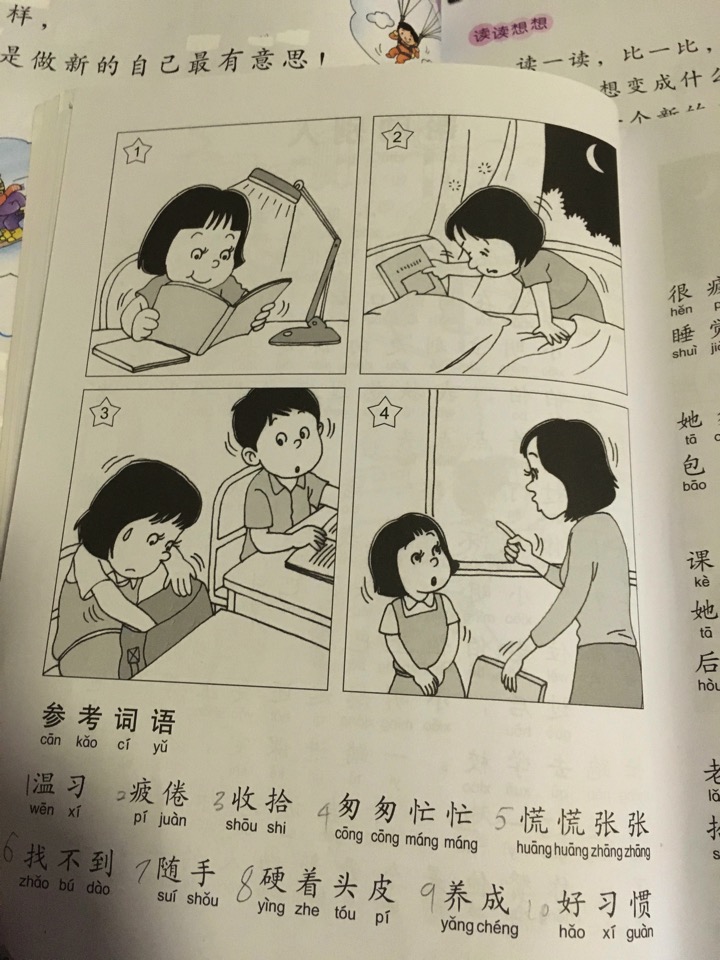
IMG 2063

Usually, I gave him 30-40 minutes to think and write.

This is important so that he gasps the idea of timing.  He cannot think too long.  What ever he thought of writing must always registered in his mind.  And he needs half of the time to write it down.

Again, the story line has to in line with the pictures.

And most of the time, he likes to use the conversation way of speaking chinese and write it into his compo.

I taught him how to use 觉得,顺手,第二天,发现, 原来, 老师知道了,答应, etc.

IMG 2052

This is the corrected copy using dictation, without looking at the notes above.
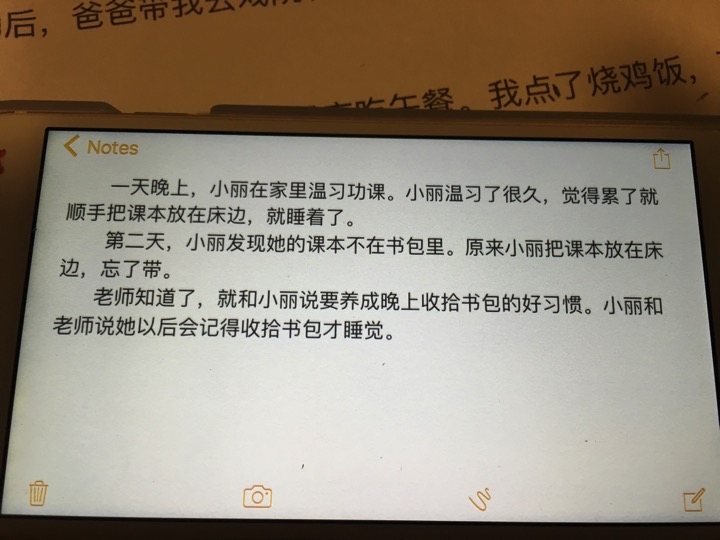
IMG 2055


[Example 3]  Talks about the boy helping a old man cross the road and explain to teacher why he is late for school.
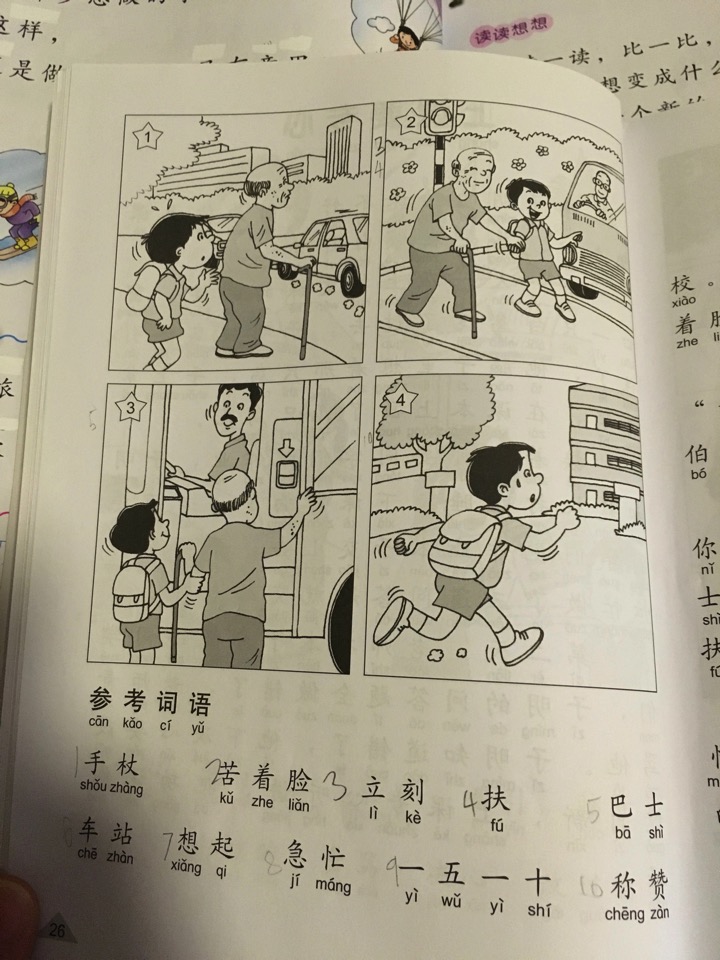
IMG 2064

This is what he came up with.  Not too bad.  

So, sometimes, it is also depending on the pictures given.  If for things that he is familiar of course he will do it well.  Those that he is not familiar, Jay tends to 转牛角尖.  That is perfectly normal.

IMG 2053

But I am glad to see him quite comfortable taking all these compositions.  He is not afraid any more, and he wanted to get high marks this time.

That is all needed from him.


[Example 4]  

Sometimes, you can ask your child to write something you see.  Not necessary to have the 4 pictures.

IMG 2051

This is the corrected version.

IMG 2050


[Example 5]

Sometimes, you can also asked the child to write super long story just to see how well he can write.

IMG 2057

IMG 2058


[Example 6]

I found that when the kid was given the iPhone to do the dictation, they are like super excited like that.  If you ask them to start writing on paper, they are like so sad.

IMG 2056

Like what I say, the best way to prepare is to constantly do it.  Practise make perfect.

IMG 2059

Practice make perfect.

But don’t expect him to be very good in writing in the first year. 

At least you know that his confident has increased by a lot that is the achievement.

Good luck!

IMG 2060

All related blogs about Chinese Compositions.

Oct 8, 2015:  http://miniliew.blogspot.sg/2015/10/p3-chinese-compo-few-more-tips.html

Sep 30, 2015:  http://miniliew.blogspot.sg/2015/09/chinese-composition-3092015.html

Sep 20, 2015:  http://miniliew.blogspot.sg/2015/09/updates-chinese-composition-jay-209.html

Sep 19, 2015:  http://miniliew.blogspot.sg/2015/09/leaning-composition-using-dictation.html

Sep 13, 2015:  http://miniliew.blogspot.sg/2015/09/updates-chinese-composition-jay.html

Aug 23, 2015:  http://miniliew.blogspot.sg/2015/08/let-it-go-butterfly.html

Aug 13, 2015:  http://miniliew.blogspot.sg/2015/08/learning-chinese-composition.html

May 4, 2015:  http://miniliew.blogspot.sg/2015/05/learn-chinese-compositions.html

Thursday, October 8, 2015

P3 Chinese Compo - Few More Tips

Date:  Oct 8, 2015

A big Happy Birthday to Jay Jay!  Today is the actual day for his birthday.

IMG 1511

As usual, we did a Chinese Composition practice during the drive between Millenia Walk and Home.

My aim was to build it Jay Jay’s thought process when writing a Chinese Composition.

Tip #1.  Sometimes, the 参考词语 (helping words) can be useful, but most of the time, it can bring some damage.  So, I told Jay, if you see some words that you are not familiar, you can choose not to use them.  You don’t have to use all the words given.  Those words are given to help you write, but most of the time, the examiner already have a story in mind which is not shown in the pictures and they thought you can write the story they want to see.  Unfortunately, P3 is the first year they really learn how to write.  So, one must know how to crawl first before walking.  Don’t stress your kid too much.  Give them guidelines, such as P3 only need to write 30 words, As long as you describe 2-3 picture correctly with some excellent words, it is fine.  Don’t imagine and describe too much.  写多错多.  And try to get rid of the “Direct translation from English” habit.

IMG 1516

Tip #2.  Write as simple as possible for a start.  P3 only requires 80 words.  So, if you write 120-150 it is enough.

IMG 1519

Tip #3.  Of course, Jay Jay uses dictation to write his composition.  You have to trained your kid to first clean up the thoughts before he or she can write out.  So, this easy method has help him come up with the skeleton of the story fast.  In fact, I timed him, give him only 10 minutes to look at the picture, look at the helping words, put the helping words beside the picture, imagine what you going to write, cross out those helping words that you not going to use, and count in mind do you have 15-20 words for every picture.  That’s it.  Once that is done, he will repeat the sentence for the picture in his mind, and uses the other 10-15 minutes to write or dictate the composition.

He wrote this down within the 30 minutes back and forth ride.  And I am truly so proud of him.  It is getting there.  So, there are one more week for the Composition paper 1.  These few days we going to go thru all the words that he had been given 听写 (Spelling) so that he knows how to write those words fast.  And of course, train him 1-2 times not using dictation, instead write it down.  So, if he can construct the story in his mind within 20-25 minutes, he should be able to write it down within the next 20-25 minutes.

IMG 1522

Tip #4.  Build the confident up.  Not to destroy it.  I don’t care at the moment, what is his teacher’s expectation.  To me, for P3, they need to produce error-fee writing for minimum 80 words which best describe the story.  So, I don’t actually allow him to read the modal answer.

Yeah.. this book come with modal answer.

IMG 1520

Building the base is very important.  So, why show the kid a perfect composition, while you already think he did a good job in writing his own version.

Because, you do not know what your kid will think when he reads the modal answer.  So, I usually cover it up and I have never ask him to take a look at the modal answer.  

This is to send a message to him that Daddy expectation is for him to write well for 80 words, not more than that.

And the book is always on his desk.  He can read the modal answer himself.  

So, the tip is never ask the kid to read the modal answer.  The kid is learning how to write, and they have to learn it with his own pace.  Forcing him to learn from modal answer is not a good move.

IMG 1521

Tip #5.  Listen more.  Read more.  To help Jay Jay to read more.  I recorded down my reading on all the story in his text book.  Jay Jay has been listen to these readings every day bit by bit.  Once he listen many times, I will ask him to read to me aloud.  You only need to ask him to read it once a day.  Not twice or thrice.  only once a day.  On a few chapter, and then, ask him to read aloud.  By doing so, the kid become more confident in reading, and understanding of Chinese will be better.  The online material from the school has the reading too.  But it is read by a Chinese (from China).  So, sometimes they do read too fast.  So, I decided to record my own voice, as it is very familiar to him, so that he can learn Chinese in a familiar way.  You can search my blog on this, try search “Learning Chinese” in MiniLiew.  Of course the 字卡 (Flash Card) is very important too.

If you don’t mind listen to my not so sexy voice, here are all the recordings for P3.

https://drive.google.com/open?id=0B_2LIa_dWu8sNUpRY0Yzak1sbVE

Good luck in teaching your kid Chinese.  This is probably the last blog entry from me on this Chinese Composition for P3.  Have fun!

Wednesday, September 30, 2015

Chinese Composition 30/9/2015

Date:  Sep 30, 2015

It’s Chinese composition time.

Remember, the more you practice, the more you will command the language and composition.

IMG 1076

Perhaps it is the weakest subject for some P3 students.  So, these blogs is to help out some parents and share with them how I teach Jay to do his Chinese composition.

IMG 1096

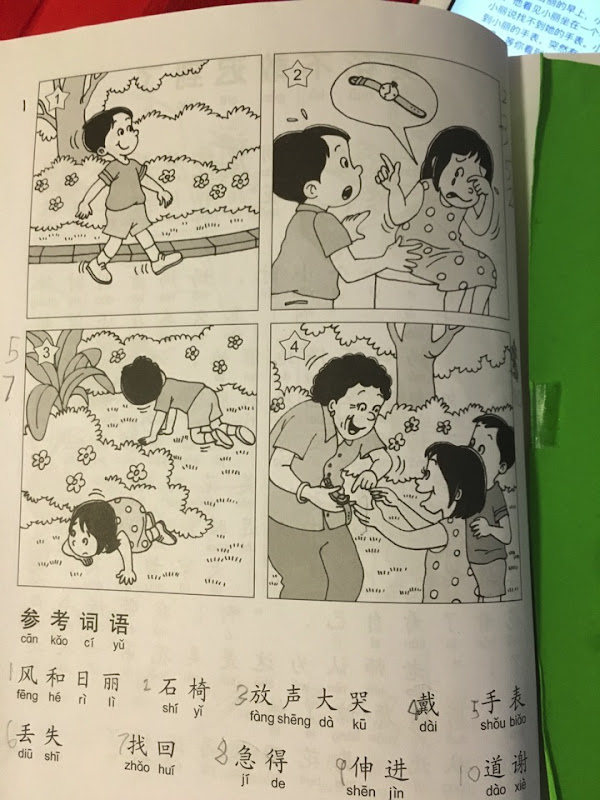
This week, I picked this topic.  As I recalled the last topic is also some one looking for something, and the two kids help the old lady find something.  So, this is a continuation of that topic.

IMG 1098

This week, I adopt another new strategy.

1.  I now asked Jay to write 2 times.  First time is the draft he did without my help.  Second draft is the one I explained to him why he cannot write this and that, and ask him to review and write a second draft just below the first draft.

2.  I asked him not to erase the first draft so that when he do the second draft, he can easily refer back to the first draft and read it out to the dictation program in iPad.  I want him to learn how to think and how to correctly describe what on his mind.

3.  I added in timer.  For coming out with the first draft, he has 10 minutes to look at the picture, and write down some notes what he want to say.  Then, another 10 minutes for the dictation to “speak” out his composition.  In real life, they will need 20-30min to write the composition.  So, he has to be trained to think fast.  As you can see, he has not finished the last sentence and he has to go Taekwondo class already.  And you can see he also pronounce not so accurately in the last sentence.  So, it does not matter, the challenge for him to quickly conceptualise the story.  

I must say, he did pretty well.  Except of the last sentence.

===== Let’s look at the two compositions and point out the obvious mistakes =====

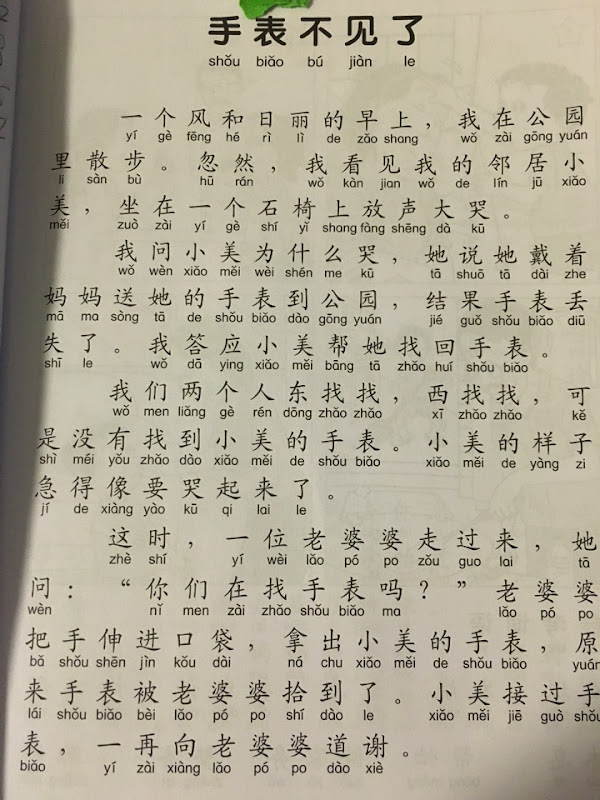
a.  I don’t like he write “他开开心心的走的时候…“ as it is like purposely write more things to lengthen the composition.  So, I taught him must always use “突然”, then, 小明 saw 小丽.

b.  Every one only got one butt.  So, the butt sit “on” the chair.  Why he has to say “坐在一个石椅上”.  There is no need to mention she sat on “one” chair and cried loudly.

c.  There is a different of saying 小丽 cannot find her watch Vs. 小丽 “lost” her watch.  When you say she lost her watch, you don’t know where she lost it.  When you say “she cannot find her watch” always imply that she actually know where is the watch, but she cannot find it.  In this picture context, using the word “lost” is more relevant here.

d.  In the original draft, 小明 saw 小丽 sat on one stone chair, and she is crying very loudly.  小明 "saw already” and he go and ask 小丽 what happen?  This sentence seems to long.  So, I teach him how to “summarise” it into 小明 saw 小丽 sat on the stone chair and cries loudly.  小明 ask 小丽 what had happen?  Which is much shorter and makes more sense.

e.  Don’t always use so many 突然.  Sometimes, you can add the time element in there, use 不一会儿.

f.  Cannot use “奶奶”.  Must use 老太太 or 老婆婆.  Usually 奶奶 is referring to your grandma.  

g.  小丽高兴的说... I told him, it was sad that she lost her watch.  But when the old lady found her watch, she should be “happy!” with the exclamation.  Very important, in every composition, you must have 1 or 2 times describing the 心情 expression.  Is she happy?  or sad.

h.  This story has no conclusion.  There is no right or wrong.  But there is happy or sad.  So, as long as you concluded the story with very happily go home, it will be enough.

IMG 1097

I am very happy about him this week coming up with this composition.  He is just learning how to write composition this year.  And he is only P3.  

Well done Jay.  I think another 1-2 weeks, he is ready for taking the MT Paper 1.

IMG 1086

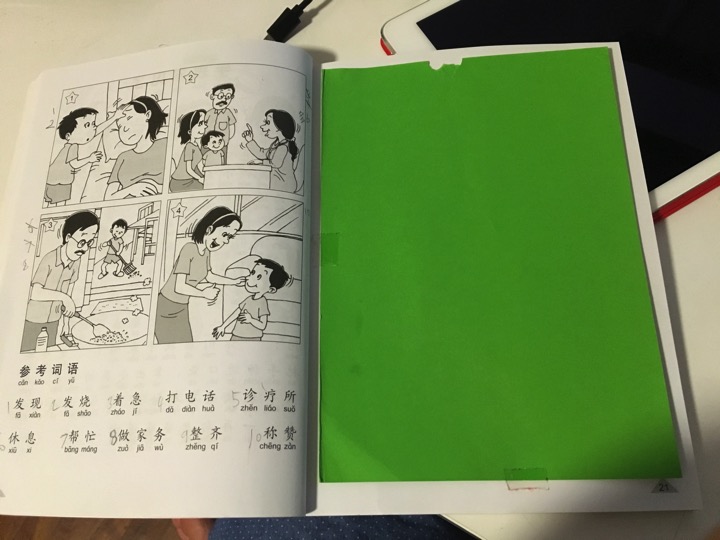
There is a reason I covered the page beside.

IMG 1100

Now, let’s see what is the modal answer.

WOW… speechless.

Remember, P3 only need to write 80 words. 

You can see how many words in the first draft.  

写多错多 … write more wrong more.

Just write around 100-120 words will do.

IMG 1099

Well done Jay Jay!!

IMG 1091

Sunday, September 20, 2015

Updates: Chinese Composition & Jay 20/9

Date:  Sep 20, 2015

We have make it a habit.

Every Saturday 2pm, while on the way to his Robotics Class, I will let Jay Jay do one passage of Chinese Composition.

It is good as we can discussed what to write, how Jay wanted to tell the story during the short 15-20 minutes ride.

And then, during the ride home, he will use the new method, IOS’s dictation to speak out and write down on the Notepad.

Screen Shot 2015 09 20 at 5 29 07 am

Through out the exercise, I discovered more on the direct translation from English to Chinese problem.

Here are some new tips that I think it is useful.

1.  I usually asked him to think about what he wanted to write and quickly do a count on words on the first 2-3 pictures.  So, he will use his fingers to start counting.  For example, he wanted to write 30 words on the first picture, and then, 20 words on the 2nd picture.  So, I teach him, once he has 50 words on the first two pictures, it is find already.  We do not need to count the 4th picture, as we know we can add more words in the last picture.  So, P3 requires to write about 80 words.  So, it has already surpass that.  This is to give him a certain confidents on how much to write.  I don’t want him to write so much because "write more wrong more "写多错多.

2.  As this is a “tell story and write story” practise.  I am not so particular on the full stop, comma, and stuffs.  When he write it down, he knows what to do.  But on a dictation mode, usually, you do not want to pay too much attention.  You want to get the “conceptualise” of the story well.  Jay understood that well.

3.  His original sentence is “小明和他的好朋友一起在公园散步”.  I reminded him that we have to always constantly asked ourselves about the 6 W’s.  In this case, where?  So, perhaps he needs to tell people more details about where he was taking a stroll with his friend.  Is it outside the garden?  Is it inside the garden?  or is it below the garden?  or above the garden?  一起在公园里散步 will be more appropriate.  The more I teach him this, the more Jay Jay grasp.  So, even during day to day conversation, I will have to watch out of this and try to remind him to be detail on describing the scene.

4.  There is nothing wrong with "他们一边谈天一边散步“.  But I have to remind him that, he has already talking about both the kids is taking the stroll.  So, by saying this again, make the sentence redundant.  So, I try to make him think, how about tell us What do they feel while they are taking the stroll and chit-chatting at the same time?  Are the boys smiling?  So, wouldn’t it be better to say "他们一边谈天一边散步, 开心极了“.  Learning to write composition is not so easy, it needs patient.  But I believe that if you keep on doing this sort of exercise on weekly, eventually the kid will learn it some days.

5.  In his original sentence, "于是小明就问,你在找什么。老婆婆说我掉了钱包。”  OK.  I have to correct him this.  He has mix up a little bit.  So, I asked him to see what other methods he can use to describe the event instead of saying “我掉了钱包”.  Reason is you are describing a person do something, and the sudden usage of “I” seems awkward.  So, I suggested him to try to describe the “老婆婆” as “她掉了钱包” instead of saying “我掉了钱包”.

6.  I am glad that he started to use “一个凉风习习的早上”,“突然”,”不一会儿“.  All these are suggested last few weeks.  In order to put the story into timing perspective.  You cannot tell a story without a time.  When does it happen?  later?  Now? 

7.  As a conclusion, the kid has to be constantly reminded about good manner.  As for now, for good behaviour, he will put down “懂事的孩子”.  Today, I want him to think about why they are “懂事”.  I told him in P4, you probably have to write more other than “懂事”.  How about saying老婆婆称赞他们是会帮助别人的好孩子。The story about how the two kids help the old lady to look for her purse.  This is an action of “helping people”.  Not so related to “懂事”.

This is what he come out of.  Not too bad.  I slowly can see the improvement.

IMG 0445

As you can see in the first picture, there are some other words that he choose not to use.  

But I think he have to start exposing himself to describing the feeling, describing what the facial expression.

Like 老婆婆很着急地在弯着身子找东西。

老婆婆好像很难过的样子在弯着身子找东西。 

老婆婆向满头大汗的小明和小华道谢。

And of course, after this, I will usually let him read what the model answer is from the book.  Those are really good, but I do not expect him to learn those.

I only wanted him to learn the correct way to speak, to describe and to write down.

So far, I am very very excited and happy about his progress.

During the car ride home, he told me that he is very happy about what he has written.  And he thank me.

And he said, he wanted to get an “A” on his SA2 paper 1.  Instead of getting a “C” as in SA1.

I told him, don’t put too high the bar, one step at a time.  I am happy if he gets an “B”.

I feel that he has grown up a lot.

加油哦!新杰!

To my friends who has kids.  I speak Chinese at home too.  But somehow the kids has evolve to make English their first language.  We cannot change that.  So, we shall need to put in more efforts to counter that effect.  We sometimes have to put in a lot a lot of efforts into teaching Jay and Kay how to speak Chinese at home, and how to speak correctly.  I shared all these because I found it very useful when teaching both Jay and Kay.  This year, I did not asked Jay do any assessment book.  I only teach him using flash cards, listen and reading out the text book, and using dictation to conceptualise and write down the composition.  And these are the basic root they need the most.  It is the confident they need to find.  So, using these easy methods, I feel that we have successfully make Jay Jay found his confident in this Chinese language.  And the more he learned, the more he wanted to learn.  Good luck!

Saturday, September 19, 2015

Leaning Composition Using Dictation

Date:  Sep 19, 2015

Dictation

Stupid me!  I went and buy a dictation app from Apple Store (i.e. Dragon Dictation) where Apple IOS itself has the most powerful dictation feature of all.  HaHaHa….

My previous posts on Learning Composition using Dictations...

“Updates: Chinese Composition & Jay”:  http://miniliew.blogspot.ch/2015/09/updates-chinese-composition-jay.html

“Learning Chinese - Composition 作文”:  http://miniliew.blogspot.ch/2015/08/learning-chinese-composition.html

“Learn Chinese Compositions”:  http://miniliew.blogspot.ch/2015/05/learn-chinese-compositions.html


Why Do We Need Dictation For Our Kids

Learning how to write words is one thing they have to learn in school.  But learning “what to write” is more important.  Sometimes, if the kids is doing both at the same time, learning what to write and at the same time, learning how to write, that will waste a lot a lot of the time, and the impact is great.  Somehow, they will develop a blockage and fear in learning Chinese.

So, to make learning Chinese fun!  Especially when doing Chinese composition, we need a better way to teach our kids.  So, we do what we do the best, divide and conquer.  First, teach them, how to form correct sentence in their mind.  And once they figure out what to write, they simply “speak it out” and the Dictation software function will transform your speech into writings.  They can correct it all the time, by simply saying it out.  Like this, they don’t have to slow down by figuring out how to write.  That is another task.

By doing this exercise, it also correct their Chinese speaking, and so to make them more accurate when pronounce the words.  Later you will see that the dictation do sometimes record wrongly what I said because I was not speaking so clearly.  


How to Turn Dictation On

I think both IOS8 or IOS9 has this.  For Android or other OS users, you have to find yourself a way that is equivalent to using Apple iPad or iPhone.  Sorry.

Go to Settings -> General

IMG 0321

Go to "Keyboard"

IMG 0322

Under DICTATION, “Enable Dictation”, that’s it.

IMG 0323

Now, you might want to turn on Predictive too.  Just in case you say something not clear and the dictation software can predict what you are really trying to say.  

Sometimes, some parents may think it is not good as the kids might not learn their mistake if the computer is doing all the correction for them.  Up to you.

IMG 0324

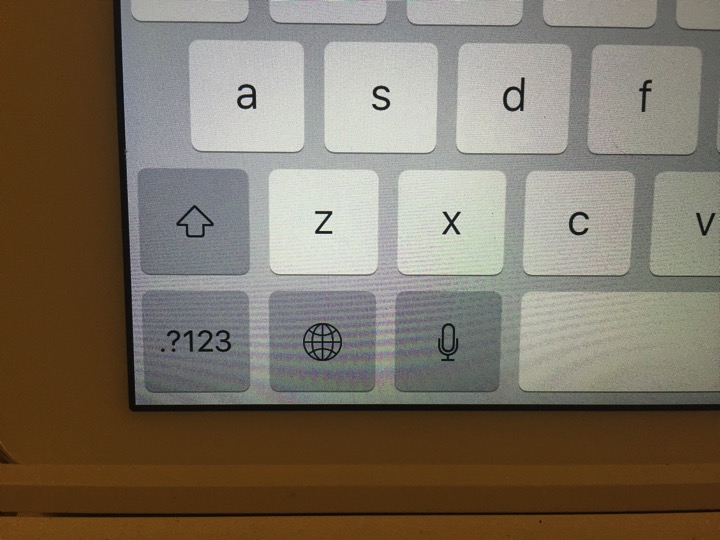
So, launch Notepad or Word or Pages, etc.  And start using dictation by pressing the MIC button.

And you can change the language the same way.  By pressing the Globe button.

IMG 0325


Videos

This is how you setup.  

And see me in action.  Speaking to the iPad and the dictation carefully jot down what I said.  I am impress with the accuracy.

Oh ya… You can toggle into English keyboard with English dictation too.

So far, I have been having a lot of positive results from teaching Jay Jay how to write compositions.  He is getting better in terms of forming the correct sentence with correct syntax, instead of direct translations from English and direct jot down from speaking.

Hope you have fun with your kids too.

Learning should be fun!

Sunday, September 13, 2015

Updates: Chinese Composition & Jay

Date:  Sep 13, 2015

Learning how to speak and write in Chinese is a long term process.

You will see the result slowly after many days.  You cannot expect to see good result in a few weeks.  

But slowly, the more you practice, the more you get familiarise and the more you learn how to write in this beautiful language.

Here is some more tips on how I train my son on how to improve his Chinese Composition.

IMG 9915

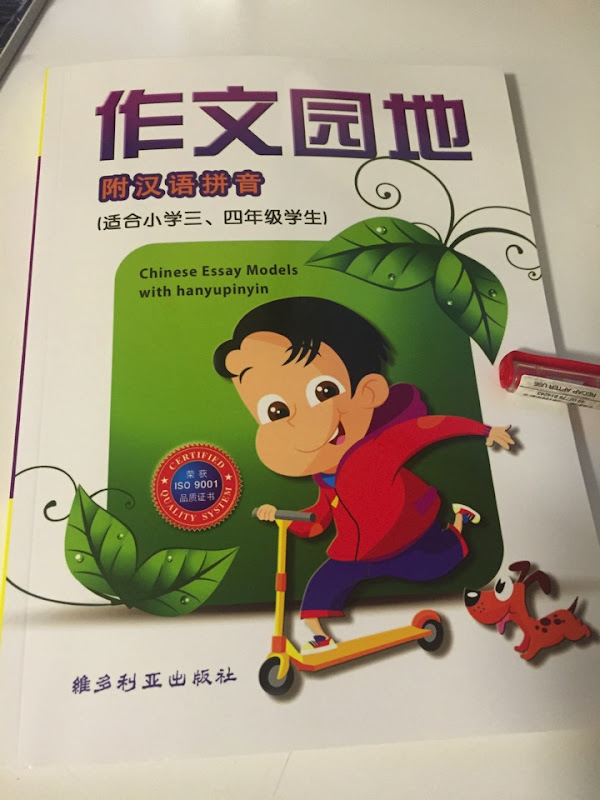
1.  You have to buy some material to practice.  One of the book I found it very useful is this book I got from Popular Bookstore.  It is by Victoria Publications Pte Ltd.  It has 72 Chinese Essay / Chinese Composition models.  With Han Yu Pin Yin too.  Of course, their model answer is very chim, deep.  But it is always good for Jay to look at the model answer. 

IMG 9919

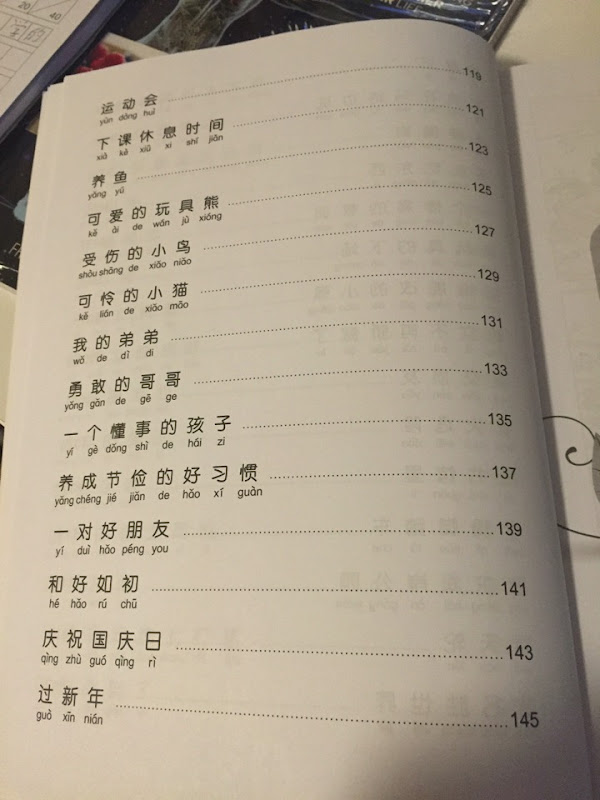
Here are the titles of the 72 Chinese Essays.

IMG 9920

Jay told me that he saw some of them in school.  Those photos are quite standard.  But of course the answers are from the Publishers.

IMG 9921

I think it is a very good idea from time to time, we pick out one topic and brainstorm together to write the Chinese Composition.  The P3 kids only need to write at least 80 words.

IMG 9922

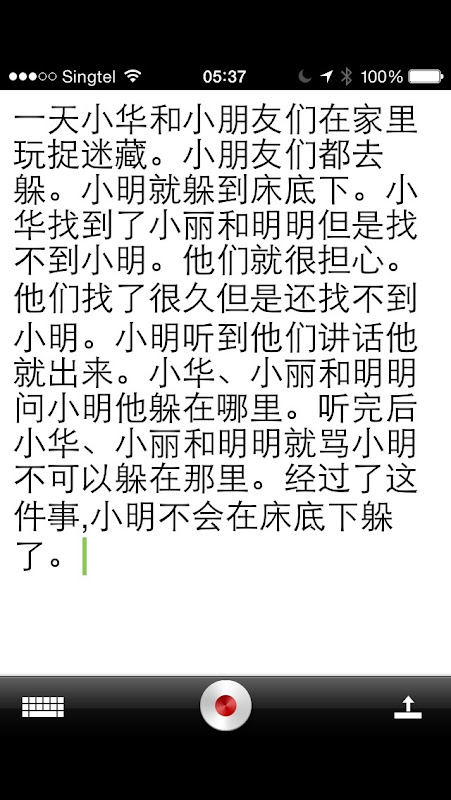
2.  In my earlier posting (you may search the blog site with “Miniliew Chinese”, you see that I uses a IOS app called Dragon Dictation.  This is a software app you use to dictate what you say into a writing.  Means, you speak to the iPhone App, and Dragon Dictation will automatically write down for you of what you speak.  This App is useful, when you want to quickly note down what you say without a pen and pencil.

IMG 9942

3.  I did the Chinese Composition together with Jay whenever we drove in the car to his enrichment class, i.e. Robotics, CMA, Golf or Badminton.  It is good as during the car journey, which is usually about 10min to 20min drive, you want the kid to use his brain to brainstorm in his mind.  Ask him to look at the pictures, tell him to describe what he sees.

The key objective is to discuss about it, and be able to describe what you see.  Describing what you see and write it down is probably the hardest part.  Our kids nowadays are slowly skewed towards English speaking mode whenever possible.  So, you have to correct his Chinese speaker all the time, when he did a “direct translation” from English.  The order of sentences are very important.  By doing this sort of exercise, you can make sure that he slowly learn how to speak Chinese in the correct order, correct way.  And as he speak correctly, he can learn how to write it down correctly too.

Today, it is the first time, we did not use Dragon Dictation.  As we are entering a higher stage.  :)

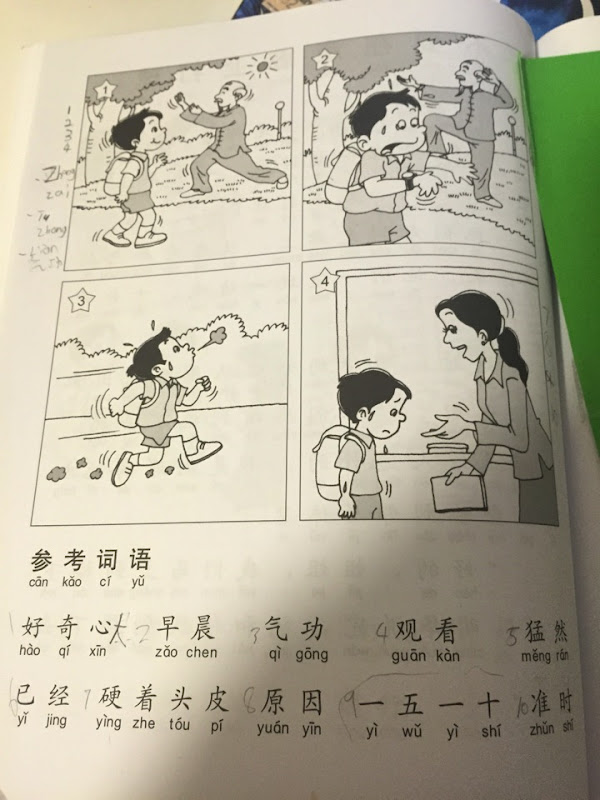
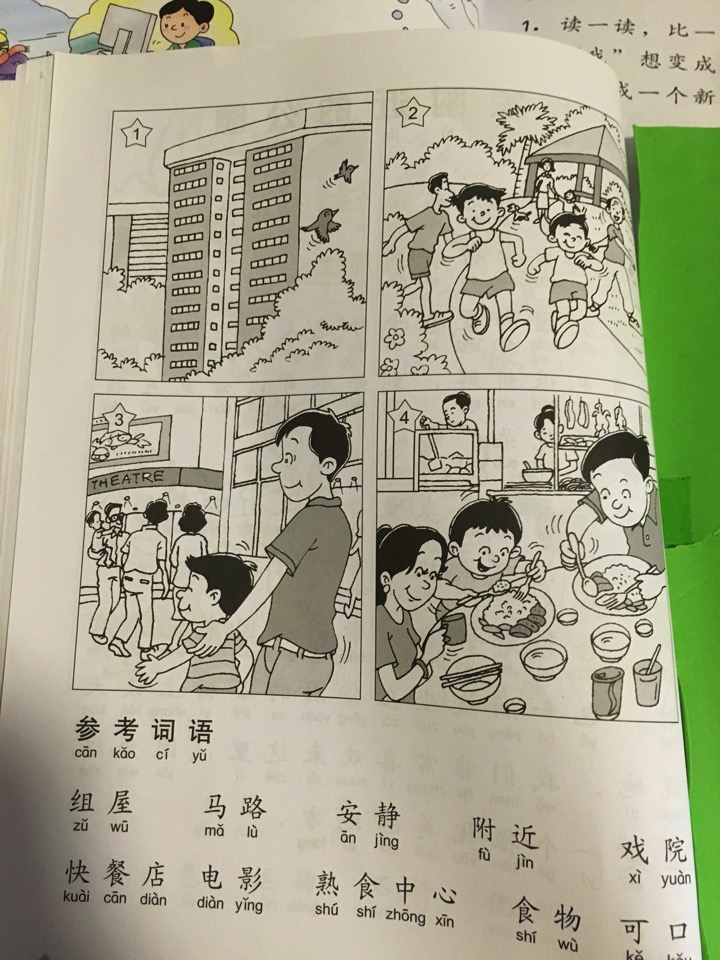
Me and Jay is discussing about these 4 pictures in the car while on our home from Robotics class.  

IMG 9916

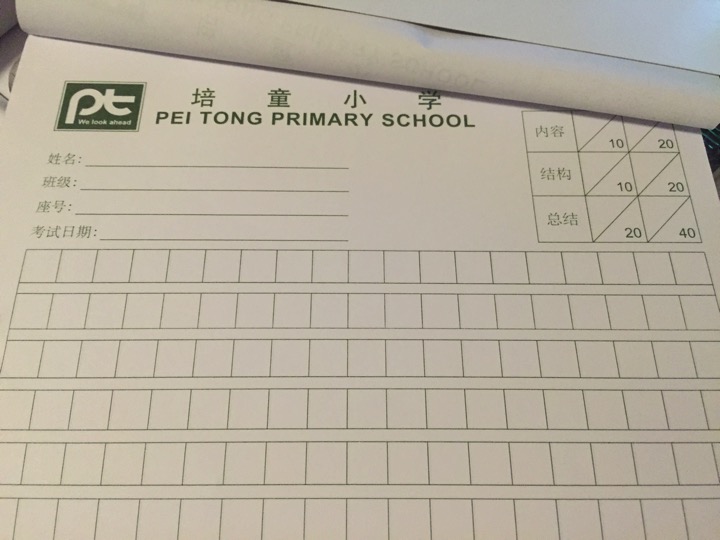
4.  First you must teach the kids how to count.  For example, there are 19 squares in each row.  So, that means, as long as you have written and “fill up” at least 5 rows, you are OK.  In P3, you are required to write at least 80 characters word counts.

IMG 9943

5.  I asked Jay to “label” all the helping words.  The key is you do not need to use up all the helping words.  But it generally gives you clues on what story is the pictures is about.

IMG 9944

6.  Then, I asked him to try to “fit” those labeled words into which pictures.  The boy is curious, so 好奇心 definitely goes into picture no. 1.  It is a lovely morning, 早晨 goes to picture no. 1.  The old man is practising his Qi Gong (气功), so it goes into no. 1.  And so on.

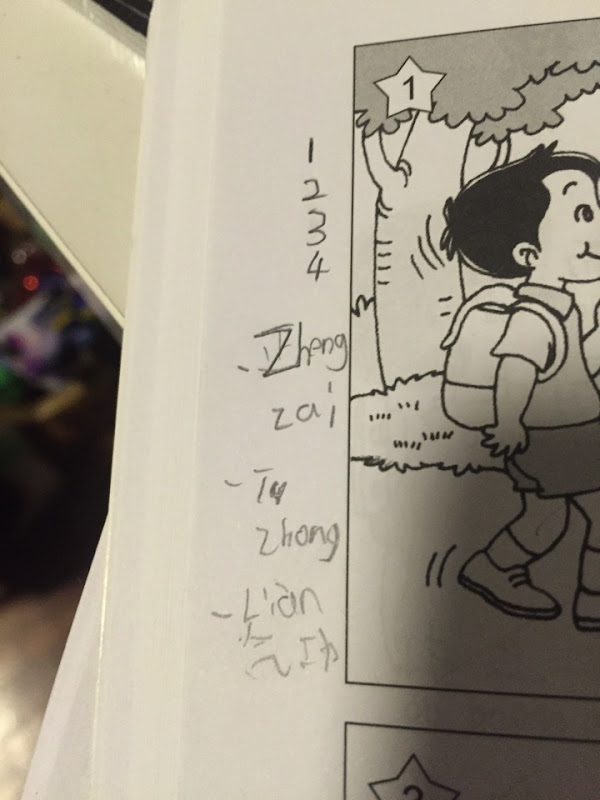
Also, if you thought of any other words, and if you DO NOT KNOW how to write it in Chinese, but you do know how to SAY IT.  Then write down the Han Yu Pin Yin beside it.  It is the fastest way to note down what you try to say.  For example, he knows how to speak out 练习气功, but he does not know how to write the Lian (练) word.  So, I would encourage him to write it down in Han Yu Pin Yin first.

IMG 9945

And he decided that 7-10 will place in the last picture.

IMG 9947

And if you decided that you don’t want to use any of the helping words, simply cross them out.  I teach Jay that if he put down the label number beside the picture, it is easier.

IMG 9946

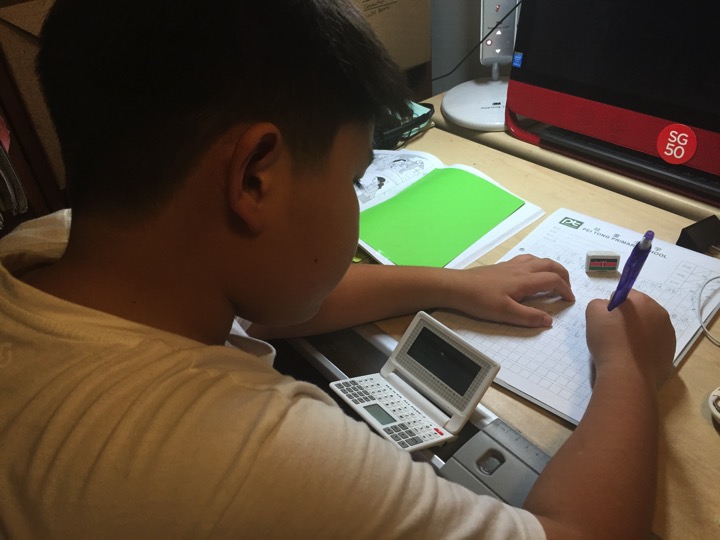
7.  In the Chinese composition class, students are allowed to use the e-dictionary.

IMG 9923

The teacher in school should have already taught them how to use it.  And you got to make sure your kids know how to use it.  So, remember, Jay wrote down the Han Yu Pin Yin, “正在“ (Zheng4 Zai4), ”途中“ (Tu2 Zhong1), ”练” (Lian4).  When he write the Chinese Composition on the paper, he will make use of the e-Dictionary to find the correct words.

IMG 9924

8.  After spending 10-20 min in the car going thru describing and telling story.  He is now ready to put it in writings.  So, when we arrive home, I tell him, you have 20-30 minutes to write at least 80 words.  So, he started to get to work.  

Notice that this time, I never use the Dragon dictation for this exercise as I want to see what is the result of what we have done for the past few weeks (only manage to do it in weekend).

Not too bad.  Not too bad at all.

So, from here, he understood clearly how much is 80 words.  So, during the brain storming sessions, we talk about almost every thing.  And whatever we spoke, may be can reach 200-300 words.  But when he write, I asked him to look at the picture again, and use your finger to do a quick count on what you want to say.  And if you think it is too short, you add in more descriptions.  If you think it is too long, try to cut down things that is repeated.  Things that is not so important, etc.  

At the moment, Jay’s Chinese tutor also let him read P5 passage.  According to the Chinese tutor, he says actually P4, P5 text book is the same.  Chinese is about learning the characters.  The more you learn the Chinese characters the more power you are.  As I spoke about it before, the way how the Chinese Tutor teach Jay is he recorded down his reading of text book on iPhone and ask Jay to read ONLY ONCE per day.  His theory is, if the student is able to read it out loud a text book passage, he should know and understand every words he read.  And you cannot force him to read two times a day as it might loose the child interest in Chinese.  You read it ONCE, is not too much.  And of course, I bought 2 extra text book for him so that one is used to write down the meaning of NEW WORDS.  And the other one, I have to blanco erase out all the Han Yu Pin Yin.  That means, when Jay read it, it has to read from a text which has no Han Yu Pin Yin.  I find this way of teaching is way way better than giving him drill or assessment books or test paper.  It is a slow way and it is a repetitive way, but it guarantee that the kid build the ROOT of Chinese in him. 

Remember, he wrote down the Lian4 (练), unfortunately he does not remember which one, so he picked “连” whites wrong.  But on a whole, when I read thru this passage, I am happy.  Because he did “improve” compare to half a year ago.  And he make use of 凉风习习 which he learned from class.  And he also uses 上气和接下气 which he learn from the P5 text book.  

So, this is a proof that Listening to the recording does work.  And make kids remember some nice words 好词好语.

To me, I don’t care how the Chinese teacher will score him, but I think Jay has done quite well in this.  Especially this is the first time I ask him to write down instead of using Dragon dictation.

IMG 9917

9.  Now, of course, there is always a model answer.  HaHaHa… of course, you DO NOT want to expect your kid to write like this in P3.  But by showing him the model answer, he will get to know that writing Chinese can be deep too.  Haha...

What I am going to do, is I am going to RECORD down both his Composition and the Model Answer.  And let him read it for 2 weeks.  So that he can remember, when he see this sort of picture, what words to use and how does 硬着头皮 & 一五一十 being used.

IMG 9918

Speak more at home.

Use correct Chinese way to speak.

And be patient on it.

Soon, and hopefully, you will get him interested in using all sort of Chinese description language to describe things.

Will share more when he do the next compositions.