Showing posts with label Fiber Broadband. Show all posts

Saturday, August 23, 2014

300Mbps or 1Gbps Internet on ViewQwest Fibernet Broadband

Date:  August 23, 2014

*****

Updates:  I found out what went wrong with my Home Network.  The culprit as I suspected is the Sineoji 600Mbps AV2 Homeplug.  Some how it drop the speed between two points from 200Mbps down to this pathetic 15.47Mbps.  Simply resetting it, it regain back to 70Mbps download speed.  I will put the result of troubleshooting at the other blog.   

*****

Today we are going to test to play the TV Streaming when the network download speed is low.

I simply wanted to prove one simple concept.


Network Setup

Don’t know why and how?  My network at home has “degraded”.  In my study room, I have a TV connected to my Minix NEO X7 box.  I am using ViewQwest 200Mbps broadband.  But don’t know start from when, it has degraded to below.

Although I am using 200Mbps.  I can get near full speed near my router.  But because I have to bring the Internet into the Network cabling using Homeplug, so, I have to suffer of losing almost 60% of the bandwidth due to power noise from Kitchen to Network cabinet.  And then, from there, it runs thru my CAT6 cable to my study room.

Previously, may be 1-2 years ago, when I did the text, I can get close to about 90Mbps for both upload and download speed.  

Today, I did the speed test again….


Speed Test

What?  my download speed is only 15.47Mbps?????  Why?  The upload speed is 76.44Mbps.  I do not know what happen, but for the past few months, I have not experience the slowness in watching streaming TV.  

I watch a lot of TV and Movies streaming from PPTV or Netflix or others.

This is the first time I did a speedtest in a year or so.   I speed test the network to ViewQwest speedtest server.

I will figure out later what happen to my network, where is the bottleneck and how to fix it.  But now, let’s try to view some direct TV streaming from it and run PPTV streaming on it.  See what is the performance like.

Yesterday, I watch 4 episodes of GTO (Japanese TV series) and 2 episodes of Hero (Japanese TV series) on PPTV on my Network.  Without any buffering.

 IMG 9379

 This is the speed test done on my iMac.  As you can see, the download speed quite sucks!


Direct TV Streaming

Take note, I have been watching TV for the past few months.  Didn’t know the download speed has degraded so much.  May be is the USB fan?  Or may be my Sineoji has degraded.  I will find out later. 

This is my Minix NEO X7 box.  Running Cloud TV with a subscriptions that I can view Direct TV programs such as HBO, National Geographics, Fox, etc and so on.

So, as you can see, when you change the channel, the load up is very fast.  Almost near to >1000KB/s.

So, with download speed of 15.47Mbps, I am able to watch HD tv streaming without any problem.


Test With PPTV Running on Slow Download Speed Network

I am testing it on my Minix Neo X7 box.  So, I run the speed test before I test the PPTV App.

And then, I will run the Speed Test again after I run the PPTV app.  So to show that the result of the slow download speed.

And what its he verdict?  No problem for me to run the PPTV.  

And PPTV is like almost instantly running.  And there is no lagging and no buffering in the middle. 

The first speed test result is 16.23Mbps download, 57.52Mbps upload.

Launching any TV show on PPTV take less than 1 second to load.  And fast forwarding the TV is also takes 1 second to reload to that fast forwarded point.

When playing, seldom you see buffering.  

The spinning indicator always shows very high value, such as 1066kB/s.  

That is what I consider as FAST.

Now, let’s do another speed test.

This time, 15.95 download speed, and 54.60 upload speed.


Conclusions

1.  I recently log onto hardware zone forum, and I see a lot of people felt very excited and post their speed test of 300Mbps, 500Mbps, and 800Mbps and so on.  But what does that mean?  Does it mean that having a low <16Mbps network will not run the PPTV well?  Apparently, that is not the case.  I have no idea when my network started to give <16Mbps download speed.  It used to have 90Mbps.  But after 1-2 years, my network has been running without any rebooting of any of my routers or homeplug.  I still watching IPTV streaming every day and I did not notice the slowness.  

2.  A typical PPTV streaming needs a constant 2Mbps to stream.  A Netflix needs 6Mbps to stream.  So, having 16Mbps download speed and 100Mbpos or 600Mbps will not have any significant differences.  As long as your ISP do not throttle your network, and your network is stable at 16Mbps, you still can do a very decent TV streaming.


OK.  Now, I need to go and trouble shoot what is wrong with my In-house Internet infrastructure.  Why suddenly drop to <16Mbps download speed.


Friday, March 7, 2014

My Internet Download Speed & PPTV Speed

Date:  Mar 7, 2014

I am on ViewQwest FiberNet Broadband plan.  Later in this blog you will see two video demonstrations about the speed of my Internet download which I am very happy about, and the power of full content PPTV.  If you are on other network, you cannot enjoy full contents from PPTV, and you might have those annoying advertisement too.

NewImage

But first let’s explain my simple home network.  What I use, and why I choose those routers.

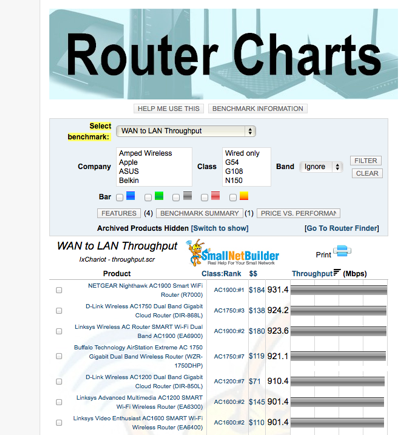
I am using D-Link Wireless AC1750 Dual Band Gigabit Cloud Router (DIR-868L) at home.  This is where ViewQwest fibre connects to.  ViewQwest does come with its own router, but those given free from ISP usually are “craps” la.  Hahahahaha.  

When you choose the router, you must select routers that has high enough CPU power and can do fast WAN to LAN downloads.  This is important.  Most of the cheap brand routers cannot do the job.  ASUS is fine.  I used to have 3x black diamond running at my home, but now, I only have 1x DLINK router that does the job.

NewImage

This is to ensure I have the best WAN-to-LAN throughput.  http://www.smallnetbuilder.com/lanwan/router-charts/view

Screen Shot 2014 03 07 at 7 41 04 am

From that router, it connects to my new Apple Extreme WiFi router.  

NewImage

Apple WiFi Router is not the fastest in the market.  But in this home, there are 4x iPads, 5x iPods, 2x iPhone 5S, 2x iMac, 1x Apple TV.  There is only 1x PC (HP Laptop for my wife office work).  So, I have to select a product that I think it is best for my Apple devices.  So, that is why I have 5x Apple Airport (Extremes and Express) installed in this home to provide seamlessly WiFi network.  When I walk out from my bed room to the kitchen, the Airport (WiFi routers) are smart enough to switch to the strongest signal AP to provide internet to my iOS devices under one single SSID.  

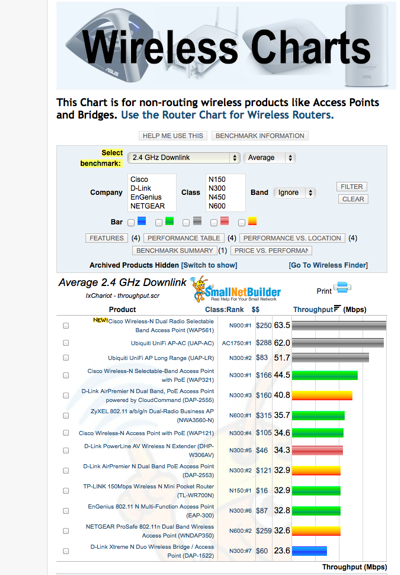
If you look at the Small Net Builder Wireless Charts, Apple AirPort Extreme is not even listed in the top 13 routers list.  

http://www.smallnetbuilder.com/wireless/wireless-charts/view

Screen Shot 2014 03 07 at 7 42 26 am

In between the WAN router and the WiFi router I am using Sineoji 600Mbps HomePlug AV2.  That is because OpenNet fibre termination box is in the kitchen washing area and between the kitchen to my network cabinet, there is no Cat6 cabling (my mistake when designing the home Cat6 cabling during renovation)

NewImage

So, below is the setup to run PPTV on iPad.  And my torrent demonstration will download the files on the iMac.


Screen Shot 2014 03 07 at 8 13 44 am


Now, let’s jump into today main topic.

Let’s demonstrate how to download a Bit Torrent TV series file.  (Please take note, downloading TV contents may infringe some copyright.  This is for demonstrations only, file will be deleted right away).

OK.  This is a boring video.  What I did is, download the torrent file, and double click on it.  Then, let my torrent downloaded (i.e. Transmission) take over and download the file I want to download.  In this case, I choose “The Big Bang Theory episode 16 of season 7.  They just showed it last Friday in US.  Of course I can watch this on PPTV.  But it still takes PPTV half day to place it onto their content page.  

I downloaded a 720p file which is good to watch on the Apple TV.  It takes about 2 minutes to download.

Last time, I used to take a long time. 

The next video I wanted to show is the PPTV.  You actually don’t have to download those torrent videos.  If you know Chinese, then, you can go to PPTV and watch the ultra HD version.  It is as good as the 720p file you have downloaded.

Things to note here is...

on ViewQwest network

1.  No advertising.

2.  The PPTV video almost launch in 1-2 seconds.

3.  All videos played in HD mode.

4.  The contents itself is different.  You will see a large selections of contents.  Few thousands shows.

5.  The contents are very new.  All Korean, Taiwan, Hong Kong, US or UK shows are up to date.

OK.  I have my 4 cores 8G Minix Neo X7 player running PPTV apps on the Android dashboard.  So, I can enjoy this on that TV set top box. 
So, that is what I call fast.

So, when I read the newspaper this morning about the “Who’s the fastest?” I have lots of doubts where all these data are collected.

And how data is collected.  

And are those data collection points equal or similar?  Some people uses fast PC, some uses slow. 

Most people don’t know how to design their Internet network and Wifi network at home.

So are the data collection points amateurs or pro?  

IMG 0897

http://www.ida.gov.sg/applications/rbs/chart.html

Then, I login to IDA website, I see these data and graphical charts.

About price.

Screen Shot 2014 03 07 at 8 28 04 am

About Download Throughput.

Note that you can actually download 209.2Mbps over a 200Mbps link.  Wahahaha.

So, I must questions why?  200Mbps is the cap and maximum size, and how can you draw more than 200Mbps if you got a cap again?

See what I mean?  

Screen Shot 2014 03 07 at 8 28 42 am

Upload throughput.

Screen Shot 2014 03 07 at 8 30 32 am

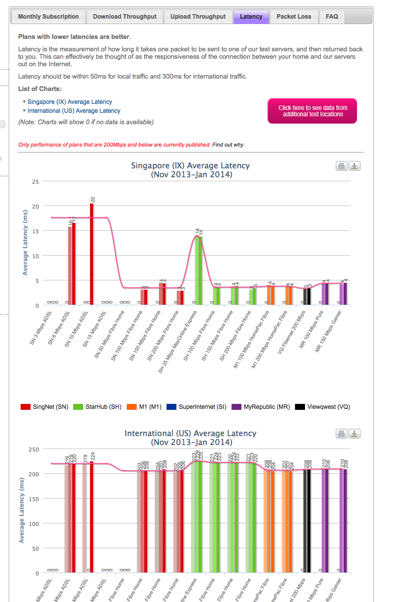
Latency.

Screen Shot 2014 03 07 at 8 31 04 am

Packet loss.

Screen Shot 2014 03 07 at 8 31 45 am

From the 5 charts, you cannot really tell what is the performance as you do not know where do they actually ping to, and download from.

What they have to demonstrates is very simple.

1.  Look at the proxy statistics find out the top 20 websites.  And measure the time to get to these 20 websites.

2.  Look at the experience of general users, figure out what they use the Internet for?  Like me, I watch TV.  So, what is the experience of this TV watching on the Internet on each broadband.

Very simple only.

All ISP providers buy from the same First Tier.  So, there isn’t any difference.  The only difference is the market value what they can give you.  And how they control traffic over the Internet.

So, we need to know how these data is collected.  What is the sample size?  is it collect over night?  or done at any particular timing, etc. 

Is it done randomly?

For me, I read the paper, and thought of doing a video, so, I immediately go in the room and shoot the video.

I am very confident as I watch TV on my Apple TV or TV media box or iPad all the time and that is what I experience.

So, at any thing, I am sure I can produce the same result.

But for these data from the website?  I am not so sure.

Are these done from 3rd party?

How is it being done?  

Who is the tester?

Sunday, March 11, 2012

My Home Network Updates

Date:  Mar 10, 2012

This is my finalized design of my home network.  It has been running for the past 7 months with ultimate performance.  :)
Kenneth Network.png
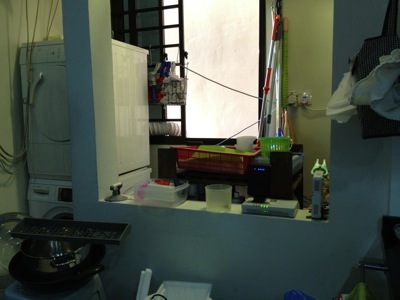
This is my washing area/kitchen.  Behind the wall on the right hand side is where OpenNet put their TP (Termination Point).  You can see I placed my ONT (Optical Network Termination) boxes there.  The main reason is I do not allow SingTel, or OpenNet to drill holes, and placed those ugly cable run from the front entrance.  So, I asked them to come in via the back door.  And the backdoor is the washing area / kitchen.  My network cabinet/cupboard is at the main entrance there.  It is there where all my entire apartment CAT6 cable runs are centralised.  And, I do not have a cable between this two location.  So, what did I do?
IMG_4794.jpg
So, in order to connect from the kitchen, I make used of two technologies.  Homeplug via the powerline and AirWire via the 5.8Ghz wifi space.  From the ONT location, there is no wired / CAT6 cable going to the network cabinet which is just left side of the kitchen (viewing from here).
IMG_4796.jpg
That is my network cabinet.  All the CAT6 network point in the house, except the kitchen, all come back to here.
IMG_4797.jpg
By the way, in my place, I have both ViewQwest and SingTel Fiber Broadband network.  The SingTel fiber broadband is notorious of throttle your traffic if they detect a slight abnomal traffic.  Once they throttle your traffic, all traffic will be slow.  So, I gave this network to my wife to use.  As she will always use it for her WebEx, Video Conferencing, etc.  As for me, I use it for my day to day web surfing and so on, I used ViewQwest Fiber Broadband that does not throttle my traffic at the moment.
1.)  So, for Singtel, I bought a pair of Airwave from X Concept.  They are the distributor of Airwave.  Now, they are located at #07-04, Burlington Square.
IMG_4775.jpg
I have used it for almost 7 months.  And it is still working fine.  I got this from X Concept.  This is a product from Ubiquiti Networks.  http://www.ubnt.com/.  A pair of this will connect at 5.8Ghz Wifi frequencies, without line of sight.  So, from the kitchen to my network cabinet.  It is brainless, simply connect and plug and play.  It is like a real cable like that.  except that they uses Wireless to connect the two points.
OK.  I know, I know, I am a techical guy, I can set up a switch and create a VLAN and pump it thru the power line using homeplug.  Those are the good old days, when you have 2 kids, your time seems to vanish pretty fast.  ahhaha so brainless thing will always catch my attention.
IMG_4776.jpg
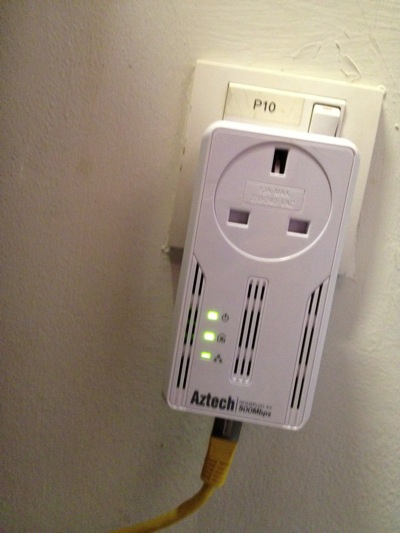
2)  So far, this is the most reliable homeplug that I have tested.  It has not been down, and does not need to reset it all the time as in the 1Gbps version.  It also have a noise filter, where you plug almost other things in there.  This one, I place it just opposite my dryer and washing machine.  My domestic helper wash cloths during day time, where all of us are working.  So, I did not get a chance to test weather the noise level is high during the washing and drying.  So far, I am happy with it.

IMG_4779.jpg

In my network cabinet, I plugged a plug extender on the noise filter of the homeplug.  That means every single electronics, i.e. switches, routers, etc are plugged in and pass thru the Aztech homeplug.  Except the NAS, I plug it separately.

IMG_4785.jpg

3)  SSID Mouse9 inside the network cabinet.  This is ASUS Black Diamond, the best WAN to LAN and LAN to WAN router in the market.

IMG_4783.jpg

4)  SSID Mouse5, running SingTel network, resides in my study room for my lovely wife to use.  Of course, the switch below is running ViewQwest network.

IMG_4788.jpg

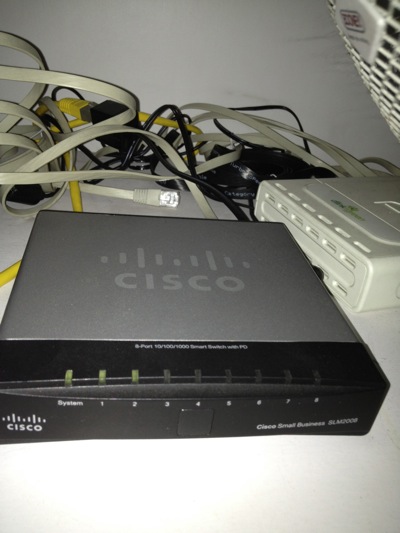
6)  As I threw away the SingTel's 2wire router.  I need this managed switch Cisco SLM2008 to untag the VLANS for me from Singtel Fiber Broadband.  I do this is to increase the performance of WAN to LAN network.  Singtel's 2wire is really crappy!

IMG_4784.jpg

7)  SSID Mouse3, sitting at the TV Console area, provides internet and Wifi exclusively to Apple TV, Wii and XBox, and my Internet Radio.  Apple Airport Extreme does the work here.  When you Airplay the movie on your IOS devices, it is fast!

IMG_4790.jpg

8)  The Internet Radio.

IMG_4793.jpg

9)  SSID Mouse6 in my bed room.  I can received 2-3 bars Wifi Signal from Mouse9, but that is not enough.  so, I put my Apple Airport Express here.

Related Posts:

From here you can explore more related topics at the botom of this post.

http://miniliew.blogspot.com/2011/05/bye-bye-singtel-2wire-5012nv.html

Friday, July 29, 2011

Home Network Improvement Plan - Asus Black Diamond

Date:  July 29, 2011

I just got a new router.  I bought it in Sim Lim for S$220.  But later, when I shop at IMM, one of the computer store beside Challenger is selling at S$209.

IMG_8499.JPG

Before that, I replaced my home Internet network router and throw away Singtel useless 2Wire 5012NV Fiber Broadband router (now it is only used for deliverying MIO TV).  I was using a D-link DIR-655.  The Wireless AP served me well for the pass two years.  It's time to change.

NewImage.jpg

My friend Larry introduced me to a website that has router comparisons.

http://www.smallnetbuilder.com/wireless/wireless-reviews/31436-asus-rt-n56u-black-diamond-dual-band-gigabit-wireless-n-router-reviewed

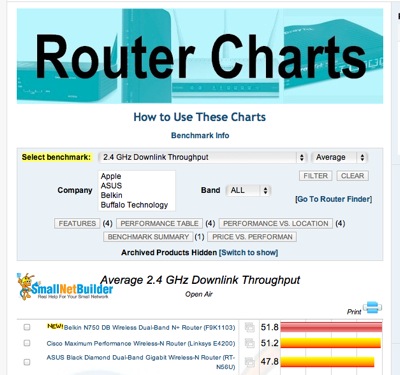
Go to this website, and start selecting your next router...  For me, I choose "Total Simultaneous Throughput" and you get ASUS Black Diamond Dual-Band Gigabit Wireless-N Router (RT-56U) as the top runner.

Screen Shot 2011-07-29 at 7.11.17 AM.png

And If I compare with the D-Link DIR-655, which is ranked 20th from the top.

Screen Shot 2011-07-29 at 7.14.03 AM.png

My Apple Extreme (ranked 14th) at home is much faster than the DIR-655 ...

Screen Shot 2011-07-29 at 7.15.48 AM.png

And in my office, I think they recently bought a Netgear WNR3500L which is ranked 18th ...

Screen Shot 2011-07-29 at 7.17.36 AM.png

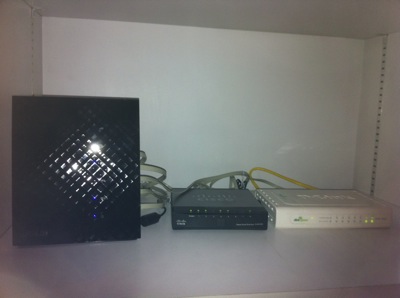
But all these routers I have seen is no where compared with Asus Black Diamond!!!  It is three times faster than my Apple Extreme.  And the router is stylist too.  One thin piece of devise standing vertically.

IMG_8515.JPG

Now, how good is this router and its AP (Wireless) function... Here are some of the test I have done in the office and at home...

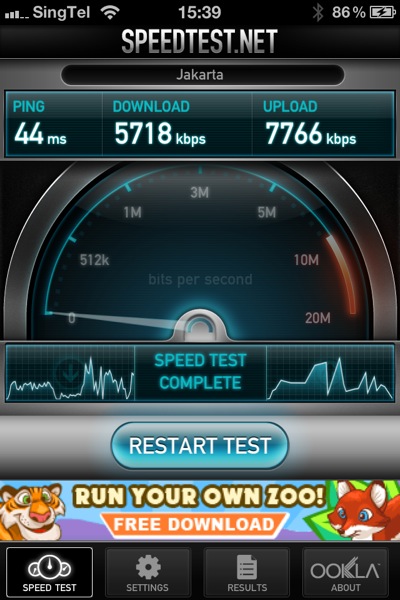
In Office We have two Wireless Access Point Router, where one ofthem is the newly bought Netplus WNR3500L... So, I run the speed test on it... As you can see I can achieve 5.7Mbps download and 7.8Mbps upload.  And I am doing the test ping to the Jakarta speed test server.

IMG_8502.PNG

Then, I disconnect the netplus, and log on to the 2nd wireless router.  I don't know what router is that, but I suspect is a cheap router too.  I will not use this AP router as a reference, as it goes to another broadband link that connects to NewMedia Test server.  I provided it here to give a reference.

IMG_8506.PNG

Then, when I plug in my new ASUS Black Diamond.... WOW... I am speechless.  I managed to get 9.1Mbps download and 14Mbps upload.  I am impressed.

IMG_8501.PNG

So, I re-run another round of testing... just to make sure I don't get some isolated results... and the results came back almost similar...

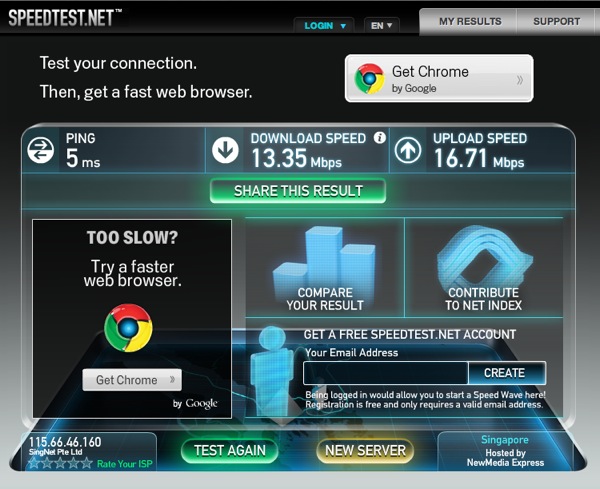
So, next thing I do, is to go back home immediately, and re-run the test at home.  So, at home, before replacing the router, this is what I get... 13.35Mbps DOWN and 16.71Mbps UP.

mouse before Test1.png

And after I plug that ASUS Black Diamond in, replacing the DIR-655...  The speed becomes 26.77Mbps DOWN and 23.85Mbps UP.  That is what I am talking about.  I had an OpenNet fiber, with Singtel Fiber Internet service of 50Mbps.  My speed should at least closer to 50Mbps, right.

wireless after door open Test1.png

So, I am speechless after I see all the result and I am very happy!

So, I go do more research.... For WAN to LAN Thruput, this is to let the Internet come into your home, handled by your router.

Screen Shot 2011-07-29 at 7.33.18 AM.png

For LAN to WAN Thruput, where your Internet going out...

Screen Shot 2011-07-29 at 7.35.40 AM.png

For Maximum Simultaneous Connections.... this is for P2P download... how mcuh you can handle when you download torrents... ASUS Black Diamond is #6 not too far behind..

Screen Shot 2011-07-29 at 7.36.18 AM.png

The 2.4Ghz Wireless Downlink thruput, Black Diamond scored #3...

Screen Shot 2011-07-29 at 7.37.53 AM.png

I think I made a right choice for the router... and I am damn happy about it.  The performance I get is much better than before... and I can feel the speed is very stable too.

GET IT NOW!

NewImage.jpg

I am still keeping my Apple Airport Extreme and Apple Airport for home Wifi access.  :)